"Why can't people be bothered to vote?"
This municipal election saw only 27.98% or 44,604 voters voting in Richmond Hill. For comparison, last Richmond Hill's 2022 municipal election had a 31.5% voter turnout. The City of Toronto had about 45% voter turnout this time. Across the province there was a 36 % voter turn out. Click HERE to see how different muncipalities vote.
So why do most people not vote in the municipal election??
Here are some reasons and solutions to consider.
Municipal government is poorly understood
People may know federal and provincial issues but not which services and decisions belong to the City or York Region.
Solutions: Provide year-round, plain-language “Municipal Government 101” information connected to everyday issues—roads, parks, libraries, development, policing and property taxes. Email newsletters from the mayor and councillors could provide this. We need to make sure that most residents receive these.
Voting does not feel consequential
Some residents may believe the outcome is predictable or that one vote will not affect City decisions. Canadian research finds that electoral competitiveness has a particularly strong relationship with municipal turnout. (Cambridge Core)
Solutions: Show how councillors votes on issues before council, and point out how this affects neighbourhoods.
Insufficient information about candidates
Local candidates receive much less sustained media coverage than provincial or federal politicians. Candidate websites and signs may provide names without enough meaningful comparison.
Solutions: Begin candidate education earlier; offer comparable questions, translated summaries, moderated meetings and short interviews in accessible formats.
Language and cultural barriers
Richmond Hill is exceptionally diverse. Only 36.2% of residents report English as their mother tongue; Mandarin, Cantonese and Persian/Farsi are widely spoken. Some residents come from places where government is not trusted or voting has not felt safe or meaningful. Basically, politics and politicians are seen as corrupt and dirty.
Solutions: Work through trusted cultural, faith and neighbourhood organizations; provide multilingual civic education—not simply translated voting instructions.
Weak connection to the community
New residents, commuters, renters and people who spend much of their day outside Richmond Hill may not feel attached to local institutions or recognize candidates’ names.
Solutions: Strengthen neighbourhood associations, such as Neighbourhood Watch, community gatherings and local storytelling throughout the four-year term. People participate where they feel they belong. Our elected officials should meaningfully be part of the community.
Distrust, cynicism or disappointment
Some people may believe politicians do not listen. Consultations are performative, or decisions have already been made. Others may dislike all the available choices.
Solutions: Demonstrate how public input changes decisions; report back after consultations; make promises and council voting records easy to follow.
An overwhelming ballot
Voters had to consider mayoral, regional, ward and trustee races. Limited knowledge—especially about trustees—can make the entire process feel intimidating.
Solutions: Create a simple, nonpartisan ballot guide explaining each office, its responsibilities and where to find comparable candidate information.
Voting-list problems
A rapidly changing population can produce outdated addresses, duplicate records or people who never receive election information. Ontario municipalities have previously reported substantial voter-list corrections. (AMCTO)
Solutions: Audit the list, report how many packages were undeliverable and conduct registration drives well before voting begins.
People were preoccupied or deliberately abstained
Cost-of-living pressures, work, caregiving, world events and election fatigue compete for attention. Some residents may consciously decide that no candidate represents them.
Solutions: Ask non-voters directly. Their reasons should not be assumed—and deliberate abstention should be distinguished from practical barriers.
For this week's past municipal election more than 80% of ballots were cast online, suggesting that providing a convenient voting method was helpful but did not, by itself, motivate most people to participate.
The Association of Municipalities of Ontario Turn Up the Turnout: A Resource On Voter Participation In Local Elections stresses that convenience alone is insufficient. Participation is also shaped by civic duty, trust, personal and cultural experiences, compelling candidates and competitive races.
The first step: listen to non-voters
What about a poll of non-voters? Could there really be a good sample of responders to the poll? If they don't vote there is a good chance they wouldn't respond to a poll, event if you could find them.
There could be some data analysis. Are there pockets of the city that have a much lower voter turnout? It would be interesting to see what the voting perspectives are by ward, age range, housing tenure, language and length of residence but that data would not be easy to procure. protecting privacy. Ward-level turnout data could also reveal whether the problem is city-wide or especially pronounced in particular neighbourhoods.
This is a four-year response—not a four-week campaign.
Let's:
Learn: Make municipal government understandable and relevant throughout the council term.
Connect: Build relationships through neighbourhoods, libraries, cultural organizations, faith communities and community groups.
Demonstrate: Show residents where participation has actually influenced a decision.
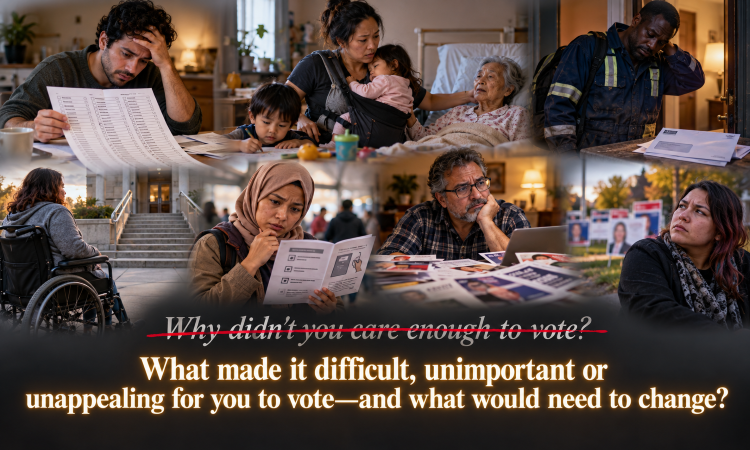
Let's change the question from “Why didn’t you care enough to vote?” to “What made it difficult, unimportant or unappealing for you to vote—and what would need to change?”
The responsibility does not rest entirely with the non-voter. Governments, candidates, media and community organizations all have roles in making local democracy understandable, trustworthy and worth joining.