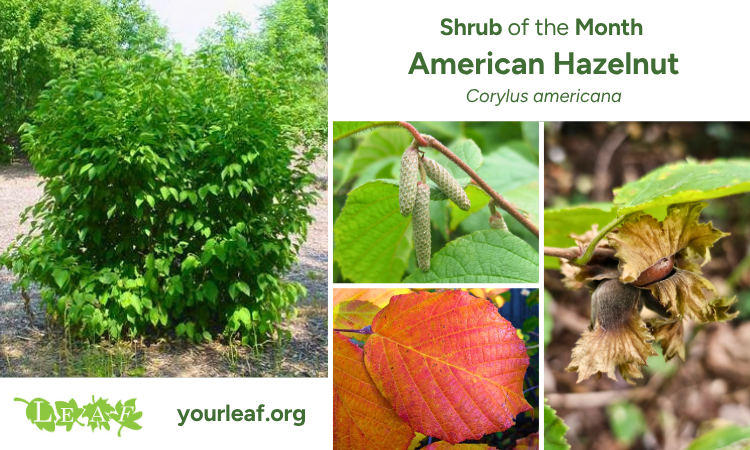
American hazelnut is a native, multi-stemmed shrub valued for its edible nuts, attractive fall colour and importance to wildlife. Native to eastern and central North America, it is commonly found in woodland edges, thickets, open forests and other areas with well-drained soils. Its rounded form, yellow to orange-red fall foliage and clusters of nuts bring seasonal interest to the landscape while providing food and habitat for birds and mammals.
Quick Facts
Height: approximately 12 feet in urban areas
Spread: approximately 8 feet in urban areas
Form: dense, rounded crown with spreading, ascending branches
Leaves: simple, darker green above and pale green below; broadly oval with a heart-shaped base and double-serrated edges; emerge in spring; shades of yellow, orange, red and purple in fall
Flowers: long, light brown to yellow male catkins and tiny, inconspicuous, scaly, grey-brown female buds with protruding bright pink to red stigmas and styles; emerge in early spring before the leaves
Fruit: small, light brown, egg-shaped nuts encased in green to brown, leafy, coarsely toothed husks; mature in late summer
Distinguishing Feature
American hazelnut is easily recognized by its small nuts, which are enclosed in distinctive leafy, coarsely toothed husks that turn from green to brown as the fruit matures.
Why We Love It
American hazelnut is a wildlife-friendly shrub that offers benefits throughout the year. Its nuts are an important food source for squirrels, chipmunks, birds and other wildlife, while its dense branching provides cover and nesting habitat. Its attractive fall colour adds seasonal interest, and its compact size makes it a good choice for naturalized gardens, woodland edges and other spaces where a larger tree would not be suitable.
Did You Know?
· American hazelnuts are an important food source for birds and mammals, but they're also edible and delicious for people. Just be prepared to work for them! The nuts are enclosed in leafy husks that can be surprisingly challenging to remove.
· American hazelnut supports a variety of native insects, including the spectacular Luna Moth and the twig-like Northern Walkingstick. Its dense branching also provides good nesting habitat and cover for birds and other wildlife.
· Its long, hanging catkins emerge in early spring before the leaves and provide an early food source for bees and other pollinators.
Plant Your Own!
Adding an American hazelnut to your yard helps create a diverse urban forest, supports wildlife and adds seasonal interest to your landscape. Plant for less with LEAF’s subsidized Shrub Planting Program today!
LEAF (Local Enhancement and Appreciation of Forests) is a not-for-profit organization dedicated to the protection and improvement of urban forests. We envision vibrant communities where everyone benefits from a healthy urban forest. For over 30 years we have been connecting people with nature through education, planting and stewardship.