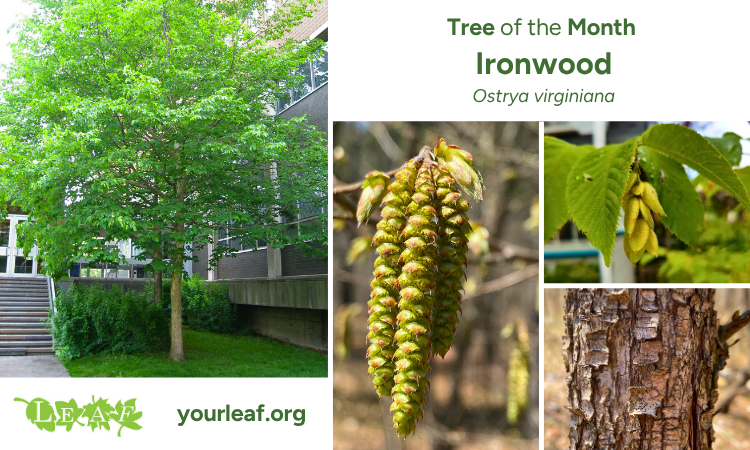
Ironwood is a small, slow-growing native tree valued for its unique appearance, adaptability and importance to forest ecosystems. Also known as eastern hop-hornbeam, ironwood gets its name from its exceptionally hard, dense wood. Its attractive bark, hop-like seed clusters and ability to thrive in partial shade make it a great choice for residential landscapes, woodland gardens and naturalized spaces.
Quick Facts
Height: approximately 25 feet in urban settings
Spread: approximately 15 feet in urban settings
Form: straight trunk with a symmetrical, rounded crown
Leaves: simple, medium to dark green above and paler green below, oval with double serrate edges; emerge in spring and turn yellow to orange in fall
Flowers: long, brown, male catkins found in clusters of 3 and long, light green, slender, female catkins; male catkins emerge in early winter and female catkins emerge in spring
Fruit: small, brown, dried, flattened, leafy clusters of sacs that resemble hops; mature in late summer and persist throughout the winter
Bark: smooth, reddish-brown when young; plated, peeling vertical strips, grey-brown when mature
Distinguishing Feature
Ironwood is easily recognized by its unique bark, which develops narrow ridges and grooves that resemble the texture of a flexed muscle. Its clusters of papery, hop-like fruits are another distinctive feature that help set it apart from other native trees.
Why We Love It
Ironwood is a resilient native tree that brings the character of Ontario’s natural forests into urban landscapes. It naturally grows as an understory tree, making it well suited for properties where a large canopy tree may not be practical. It tolerates shade, adapts to a variety of soil conditions and provides valuable habitat for wildlife. Its seeds are eaten by birds and small mammals, while its leaves support native insects that form an important part of the food web.
Did You Know?
· Ironwood has some of the hardest wood of any Ontario tree. Its dense, heavy wood was traditionally used for tool handles and other items where strength was important.
· Ironwood belongs to the birch family. Despite its name and appearance, ironwood (Ostrya virginiana) is related to birches, which helps explain why its leaves can be mistaken for those of birch, elm or blue beech.
· Ironwood is a “forest understory” specialist. In nature, it often grows beneath taller trees like maples and oaks, where it thrives in the filtered light of a mature forest.
Plant Your Own!
Adding an ironwood to your yard helps create a diverse urban forest, supports local wildlife and adds year-round interest to your landscape. Plant for less with LEAF’s subsidized Tree Planting Program today!
LEAF (Local Enhancement and Appreciation of Forests) is a not-for-profit organization dedicated to the protection and improvement of urban forests. We envision vibrant communities where everyone benefits from a healthy urban forest. For over 30 years we have been connecting people with trees through education, planting and stewardship.